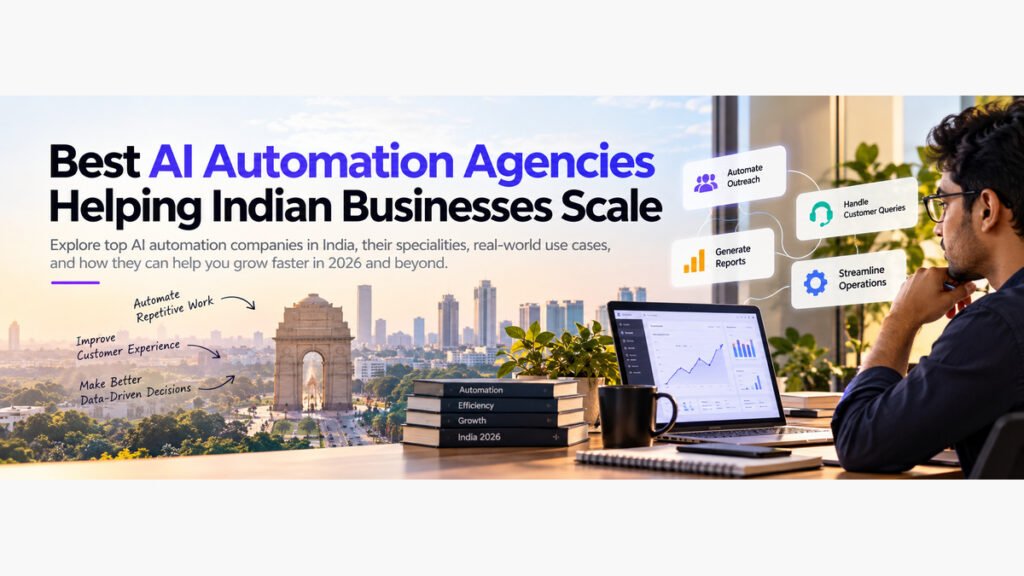
Best AI Automation Agencies Helping Indian Businesses Scale

A sales representative receives a new enquiry. They review the customer’s requirements, search for relevant information, update the CRM, prepare a response, and schedule a follow-up.
Meanwhile, the customer support team is answering the same questions for the hundredth time, and the operations team is manually transferring information between spreadsheets and business applications.
None of these tasks is particularly complicated on its own. Together, however, they consume hours that employees could spend serving customers, solving problems, and growing the business.
This is where AI automation is becoming increasingly useful.
Businesses are exploring AI-powered workflows that can interpret customer enquiries, retrieve information from internal systems, process documents, coordinate tasks, and support decisions. More advanced systems can use AI agents to complete multiple connected steps instead of responding to a single instruction.
But choosing the right solution is not as simple as finding a company that offers AI services.
Some providers specialize in conversational AI. Others focus on enterprise transformation, document processing, data engineering, or custom AI agent development. The right partner depends on the problem you need to solve.
In this guide, we compare 12 AI automation companies and technology providers worth evaluating, explain what distinguishes their approaches, and share practical ways to determine whether an AI automation project makes sense for your business.

Quick Comparison: AI Automation Companies to Consider

Anvenssa AI focuses on enterprise AI agents and conversational intelligence, making it worth exploring for custom business workflows. Arthat AI offers AI workflow implementation and business process automation for businesses seeking practical, phased adoption.

Tata Consultancy Services (TCS) provides enterprise technology and AI transformation capabilities suited to large organizations. Infosys focuses on enterprise AI and digital transformation, particularly for complex enterprise environments. Wipro offers AI services and technology transformation for organizations modernizing their operations.

Quantiphi works across data, cloud, machine learning, and generative AI, making it relevant to data-intensive AI projects. Persistent Systems offers AI engineering and enterprise modernization capabilities for custom applications and enterprise systems.

Haptik specializes in conversational AI for customer-facing interactions, while Yellow.ai focuses on conversational automation and customer experience for customer service and engagement. Datamatics offers intelligent automation and document processing for document-heavy operations. ThirdEye Data works in data engineering and AI development, and Zynteq offers AI automation services and workflow solutions.

This is a practical shortlist, not a verified ranking of the 12 best providers. These companies have different business models, product offerings, and implementation capabilities. Their inclusion does not imply that they offer identical services or that one is objectively better than another.


What Does an AI Automation Agency Actually Do?

An AI automation agency helps businesses identify processes that can be improved through artificial intelligence, workflow automation, software integrations, and data.
Traditional automation works well when a process follows predictable rules. AI becomes useful when the workflow also involves interpreting language, understanding documents, retrieving information, or handling variable inputs.
For example, a conventional workflow might route every enquiry containing a particular keyword to the sales team. An AI-enabled workflow could interpret the enquiry, extract the customer’s requirements, categorize the opportunity, and prepare a response for review.
Depending on the business problem, an implementation may involve large language models (LLMs) for language understanding and generation, retrieval-augmented generation (RAG) for answering questions using approved business information, and APIs and integrations to connect CRM, ERP, help desk, and other applications. It may also involve workflow orchestration to coordinate multiple steps, AI agents that use approved tools to complete tasks, and monitoring, validation, access controls, and human approval for sensitive actions.
An important distinction is that an AI tool, an AI agent, and an AI automation agency are not the same thing.
A software vendor may provide a ready-made platform. An AI agent may perform tasks within that platform. An agency or implementation partner may design and connect the complete workflow around the business’s requirements.
Some companies provide more than one of these services, so it is worth checking what you are actually buying.

12 AI Automation Companies Explained

1. Anvenssa AI

Anvenssa AI focuses on enterprise AI agents, generative AI applications, conversational intelligence, and business automation. Its website describes applications involving sales engagement, customer conversations, business intelligence, WhatsApp engagement, and integration with business tools. These areas are relevant to organizations looking to connect AI capabilities with existing workflows rather than use a standalone chatbot. Areas to explore include AI agents for sales and customer interactions, conversational intelligence, enterprise generative AI and knowledge retrieval, business workflow automation, and integration with existing applications. Businesses exploring custom AI workflows for sales, support, and operations may consider Anvenssa AI, particularly when the solution needs to work with existing business data and systems. Before choosing, request a demonstration of the exact workflow you want to automate. Ask how data access is controlled, how the system handles incorrect or incomplete information, and which performance metrics will be used to evaluate the implementation.

2. Arthat AI

Arthat AI’s published guide takes a practical approach to automation, emphasizing business processes, implementation, pricing models, and the evaluation of potential providers. Its website describes a phased approach that starts with assessment, proceeds to a focused workflow implementation, and can expand into ongoing support. Its areas to explore include sales and marketing automation, operational workflow automation, content and creative workflows, AI implementation and optimization, and assessment and adoption planning. Businesses that want to identify a manageable starting point, implement a focused automation project, and expand after evaluating the results may find this approach relevant. Before choosing, clarify what the first implementation includes, how the team will measure its impact, and what happens after the initial project is delivered.

3. Tata Consultancy Services (TCS)

TCS is a large IT services and consulting provider with capabilities across enterprise technology, data, cloud, and AI-led transformation. For organizations with complex systems and multiple departments, the broader technology environment can matter as much as the AI model itself. A successful implementation may need to connect with existing applications, security policies, infrastructure, and operational processes. Areas to explore include enterprise AI transformation, AI and data engineering, cloud and application modernization, and business process and technology integration. Large organizations that need AI initiatives to fit into wider enterprise technology and transformation programs may consider TCS. Before choosing, establish which team will deliver the proposed solution, what the project scope covers, and how the implementation will be measured.

4. Infosys

Infosys provides enterprise technology services, consulting, and AI-related solutions. Its broader capabilities make it relevant to organizations considering AI alongside application modernization, data management, and business process transformation. Areas to explore include enterprise AI solutions, generative AI applications, data and cloud capabilities, and AI-enabled business transformation. Enterprises that need AI initiatives to work within existing applications, data platforms, and operational processes may consider Infosys. Before choosing, request a proposed architecture that explains how the AI solution will interact with existing systems, how it will be tested, and which responsibilities remain with the internal team.

5. Wipro

Wipro works across technology consulting, AI, cloud, data, and business transformation. These capabilities may be relevant when an organization needs to introduce AI as part of a larger technology or operational change. Areas to explore include AI and generative AI services, enterprise application integration, intelligent automation, and technology and process transformation. Organizations exploring AI initiatives alongside infrastructure, applications, and broader business operations may consider Wipro. Before choosing, ask how the provider will separate the AI component from conventional automation and which parts of the process can be simplified without using AI.

6. Quantiphi

Quantiphi focuses on data engineering, cloud, machine learning, and AI solutions. These capabilities are relevant when an automation project depends on substantial data preparation, model development, analytics, or cloud infrastructure. Areas to explore include generative AI applications, machine learning, data engineering and analytics, and cloud-based AI solutions. Businesses whose AI use cases depend on complex datasets, predictive models, or custom AI engineering may consider Quantiphi. Before choosing, understand what data preparation is required, how model performance will be evaluated, and which infrastructure and operating costs will continue after deployment.

7. Persistent Systems

Persistent Systems provides software engineering, data, cloud, and AI-related services. Its engineering focus can be relevant when organizations need to build AI-enabled applications or connect intelligent features to existing enterprise systems. Areas to explore include AI engineering, generative AI applications, enterprise modernization, and data and software development. Businesses building custom software, modernizing existing applications, or incorporating AI into enterprise products may consider Persistent Systems. Before choosing, request a clear explanation of the system architecture, testing approach, maintenance requirements, and ownership of the implementation.

8. Haptik

Haptik is associated with conversational AI and customer engagement solutions. Conversational systems can help businesses manage routine enquiries, provide information, and guide customers through supported processes. Areas to explore include conversational AI, customer support automation, digital customer engagement, and messaging-based experiences. Businesses looking to improve customer-facing interactions through conversational interfaces may consider Haptik. Before choosing, test the system with realistic customer questions, including ambiguous requests and cases that require human escalation. Confirm which channels and integrations are supported by the proposed solution.

9. Yellow.ai

Yellow.ai provides conversational AI and customer experience automation capabilities. Businesses evaluating conversational platforms may consider how well they support the channels, languages, and workflows relevant to their customers. Areas to explore include conversational automation, customer service workflows, digital engagement, and voice and messaging experiences. Organizations seeking to automate parts of customer service and customer engagement across supported communication channels may consider Yellow.ai. Before choosing, confirm channel coverage, integration requirements, language performance, and how the system transfers a conversation to a human when necessary.

10. Datamatics

Datamatics offers intelligent automation capabilities, including document processing and automation of business tasks. Its published resources describe applications involving document capture, structured and unstructured information, and industry-specific workflows. Explore Datamatics intelligent automation Areas to explore include intelligent document processing, robotic process automation, AI-assisted document extraction, and business process automation. Organizations handling large volumes of invoices, forms, purchase orders, and other documents that require manual extraction or validation may consider Datamatics. Before choosing, test the solution using representative documents, including poor-quality scans and unusual formats. Ask how it detects extraction errors and routes exceptions for review.

11. ThirdEye Data

ThirdEye Data works in data engineering and AI development. For AI projects that rely on multiple information sources, data quality and integration can be as important as the model selected. Areas to explore include data engineering, AI and machine learning development, generative AI applications, and data-intensive business solutions. Organizations that need custom AI development supported by data integration and engineering may consider ThirdEye Data. Before choosing, establish which data sources will be used, how the solution will be validated, and how the resulting application will be monitored in production.

12. Zynteq

Zynteq has published a comparison of AI automation providers that highlights practical evaluation criteria, including deployment speed, pricing transparency, multilingual capabilities, voice AI, and enterprise experience. Read its comparison guide. These are useful criteria for evaluating any provider, although the company’s own comparison should be treated as an editorial source rather than an independent industry ranking. Areas to explore include AI automation services, workflow and integration requirements, conversational and voice automation capabilities, and implementation approach and support. Businesses investigating AI automation solutions and looking for a provider whose capabilities match a clearly defined workflow may consider Zynteq. Before choosing, request relevant project examples, clarify supported integrations, and compare the proposed solution against at least one alternative.

Which Type of AI Automation Provider Is Right for Your Business?

The most useful way to compare providers is to start with your requirements instead of choosing a company based on its position in a list.
For automating sales follow-ups, prioritize CRM integrations, lead qualification, approval rules, and tracking. For improving customer support, prioritize knowledge retrieval, channel support, escalation, and response quality.
For processing invoices and documents, look at extraction accuracy, validation, exception handling, and audit trails. For connecting enterprise systems, prioritize APIs, architecture, permissions, security, and maintainability.
For building a custom AI application, evaluate AI engineering, data preparation, evaluation, and deployment. For automating internal workflows, focus on workflow design, reliability, monitoring, and employee adoption.
A company that specializes in one area may be a better fit for a focused project than a larger provider offering a broad portfolio of services.
Equally, a business with complex integration requirements may benefit from a provider with substantial enterprise engineering experience.
The goal is to find the best match for the problem, not the company with the most impressive marketing language.

Anvenssa AI

🚀 Ready to See How AI sales Agnets Works ?

Let's show you how Anvenssa AI can work for you.

🎯 Book a Demo

What Can Indian Businesses Actually Automate?

AI automation becomes easier to evaluate when the use case is specific.

Sales and lead management

A system can categorize incoming enquiries, extract customer requirements, update selected CRM fields, draft follow-up messages, and alert sales representatives when a lead needs attention. The value comes from reducing delays and improving consistency. Actual conversion improvements must be measured against the existing process.

Customer support

An AI-enabled workflow can retrieve answers from approved documentation, classify support tickets, prepare responses, and route unresolved cases to the right team. Sensitive requests may still require human review or authorization.

Marketing operations

AI can help organize research, cluster search queries, draft content outlines, summarize campaign performance, and support reporting. Human review remains important for accuracy, originality, brand voice, and publishing decisions.

Finance and document processing

AI-assisted extraction can identify fields in invoices and purchase orders, while conventional validation rules check amounts and required information. Discrepancies can be routed for approval rather than passed automatically into financial records.

Internal knowledge management

A retrieval-augmented generation system can search approved documents and produce answers with source references. Access controls must ensure employees can retrieve only the information they are authorized to see.

Inventory and operations

A workflow can combine stock information, reorder thresholds, supplier details, and purchase history to flag potential issues or prepare recommendations. Actions with financial or operational consequences should follow defined approval rules. These examples describe possible applications, not guaranteed results. Whether a workflow is suitable depends on available data, existing systems, error tolerance, and the quality of implementation.

AI Automation vs. AI Agents vs. Traditional Automation

These terms are often used interchangeably, but they describe different things.
Traditional automation executes predefined rules and steps. For example, it sends an alert when stock falls below a threshold.
AI-assisted automation uses AI for a specific part of a workflow. For example, it extracts invoice information and checks it against business rules.
An AI agent uses available tools and information to complete a task through multiple steps. For example, it reviews an enquiry, retrieves approved product information, and prepares a response.
A multi-agent system coordinates multiple agents or specialized components. Separate components might handle research, validation, and response preparation.
A multi-agent system is not automatically better than a simpler workflow. More components can introduce additional complexity, latency, and failure points.
For many businesses, the best solution combines conventional automation with AI only where interpretation or flexible reasoning is necessary.

What Should You Check Before Hiring an AI Automation Agency?

A convincing demonstration is a useful starting point, but it does not establish that a system will work reliably in a production environment. Ask for a relevant demonstration. Request a working example of a workflow similar to your intended use case, rather than relying solely on a presentation. Understand the integrations. Confirm which applications, APIs, databases, and communication channels the system needs to access. Check data handling. Ask where data is processed and stored, how access is controlled, and what happens to information sent to third-party model providers. Test failure handling. Find out how the system handles incomplete information, incorrect outputs, unavailable APIs, and tasks that require human intervention. Define measurable outcomes. Establish a baseline and agree on metrics such as processing time, error rate, manual effort, and cost per completed task. Clarify ownership. Determine who owns the code, configuration, documentation, credentials, and integration assets, and whether your team can maintain the system independently. Review ongoing costs. Include model usage, infrastructure, maintenance, monitoring, support, and any required software licences. For Indian businesses handling personal data, compliance requirements should also be considered during system design. Legal and regulatory obligations depend on the data, use case, and applicable rules.


How Much Does AI Automation Cost in India?

There is no universal price for an AI automation project.
Costs depend on the number of workflows, complexity of integrations, quality of available data, deployment environment, security requirements, and level of ongoing support.
A simple workflow using existing tools may require relatively little development. A custom enterprise system connecting several applications, using sensitive data, and requiring extensive testing can involve substantially more work.
Before comparing proposals, ask each provider to separate the costs of discovery and solution design, development and integration, testing and deployment, model usage and infrastructure, monitoring and maintenance, and employee training and operational support.
Ask for a defined scope, delivery assumptions, acceptance criteria, and a clear explanation of what is not included.
Do not compare quotations solely by their initial price. Consider the full cost of operating and maintaining the system, as well as the business outcome it is intended to deliver.

Frequently Asked Questions

Which is the best AI automation agency in India?

There is no single provider that is best for every business. The right choice depends on the workflow, integration requirements, security needs, budget, implementation experience, and evidence of relevant results.

What is the difference between an AI automation agency and an AI software company?

An AI automation agency generally helps design or implement solutions around business workflows. An AI software company may primarily provide a standardized platform or product. Some providers offer both services.

Can AI automation work with existing CRM and ERP systems?

Yes, where suitable APIs, connectors, or supported integration methods are available. The project must account for authentication, permissions, data quality, and error handling.

Is AI automation suitable for small and medium-sized businesses?

It can be suitable when the business has a clear, repetitive process and the expected benefit justifies the implementation and operating costs. Starting with one focused workflow can be more practical than attempting a company-wide transformation immediately.

Does AI automation eliminate human involvement?

Not necessarily. Routine, low-risk tasks may be automated more extensively, while sensitive decisions and actions with financial, legal, or operational consequences may require human review or authorization.

How do you measure the ROI of AI automation?

Compare the current process with the automated workflow using relevant measures such as processing time, labour effort, error rates, operating costs, and completed tasks. Include implementation and recurring expenses in the calculation.

Final Thoughts: Choose the Workflow Before Choosing the Agency

AI automation offers businesses new ways to reduce repetitive work, improve access to information, and coordinate tasks across existing systems.
But successful implementation depends on more than selecting a model or hiring a provider with an impressive portfolio.
The business needs a clear problem, reliable data, appropriate integrations, sensible safeguards, and a way to measure whether the solution is working.
For one organization, the best starting point might be lead qualification. For another, it might be document processing, customer support, or inventory management.
Start with the process that matters most, evaluate potential partners against the same criteria, and expand when the evidence supports it.
The most useful AI automation project is not the one with the most features. It is the one that solves a real business problem reliably.

Related Posts