
Most businesses already have access to data. The problem is that data alone does not drive action. Reports are reviewed weekly. Dashboards are checked monthly. By the time someone reads an alert and decides what to do, the moment to act has often passed.
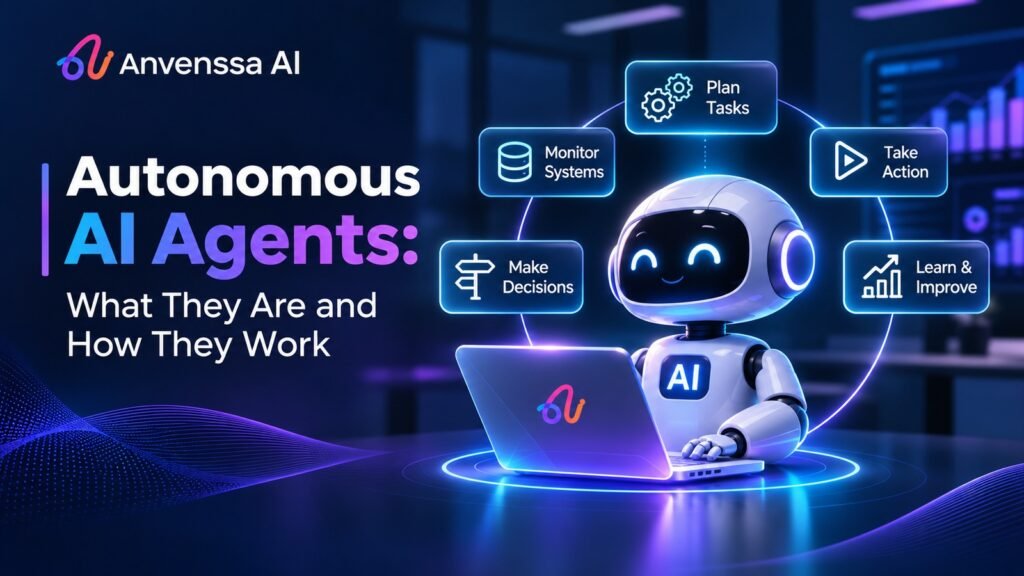
Autonomous AI agents change that. They do not wait for instructions. They monitor systems, understand what is happening, choose the best action, carry it out, and learn from the results. They are not just analytical tools. They are operational ones. This article explains what autonomous AI agents actually are, how they work, what makes them different from other AI tools, and where they are creating real value for businesses today.
What Is an Autonomous AI Agent?
An autonomous AI agent is a software system that works from a goal rather than a fixed script. You give it an outcome, and it decides how to get there. It plans the steps, uses tools like APIs and databases, checks its own results, and adjusts until the job is done or it needs to pass the task to a person.
Three things define an autonomous agent and separate it from tools that simply respond or follow rules:
-
Goal-directed planning: The agent receives an objective, not a list of instructions. It breaks the objective into steps on its own and adapts when conditions change.
-
Tool use: The agent calls APIs, queries databases, reads documents, and interacts with other software systems to get work done.
-
Independent decision-making: The agent picks its next step based on what it observes. It does not need a person to approve every move, though it knows when to escalate.
The word “autonomous” does not mean unsupervised. Well-designed agents operate inside clearly defined goals, permissions, and safety limits. The autonomy is what happens inside those limits, not beyond them.
Autonomous Agents vs. Chatbots vs. Rule-Based Automation
These three tools are often grouped together, but they work in very different ways. A chatbot responds to messages one step at a time. The user drives the conversation. The chatbot answers a question or makes a recommendation, but it does not go and complete a task. Rule-based automation follows fixed conditions set by a programmer. If a certain thing happens, it triggers a predefined action. When conditions fall outside what was programmed, the automation stops. An autonomous agent does something neither of the others can. It receives an objective, sequences the actions needed to reach it, observes what happens after each step, and adapts until the work is done.
Chatbots
A chatbot responds to messages one step at a time. The user controls the conversation, and the output is generally an answer or recommendation.
Rule-Based Automation
Rule-based automation runs fixed, predetermined rules. The programmer controls the workflow, and the system produces a predefined action when specified conditions are met.
Autonomous AI Agents
An autonomous AI agent receives an objective, sequences actions, and adapts to the results. It operates within defined goals and permissions and produces a completed task or escalates when it cannot finish.
A simple example makes the difference clear. Consider a customer requesting a refund.
-
The chatbot answers the billing question.
-
The automation issues the refund when preset conditions are met.
-
The autonomous agent interprets the request, checks the account, determines eligibility, issues the refund, updates the record, and notifies the customer.
The agent does not replace the other tools. Many workflows combine all three: a chatbot handles the front end, rules manage the fixed steps, and an agent handles the judgment calls in between.
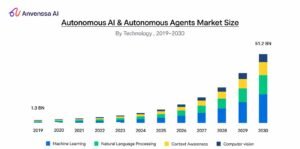
Autonomous AI & Autonomous Agents Market Size by Technology, 2019–2030

The global autonomous AI and autonomous agents market is growing rapidly, from $1.3 billion in 2019 to a projected $51.2 billion by 2030. Growth is driven by four key technologies: Machine Learning (the largest segment), Natural Language Processing, Context Awareness, and Computer Vision. The market is expected to nearly double every two to three years through the end of the decade.

How Autonomous AI Agents Actually Work
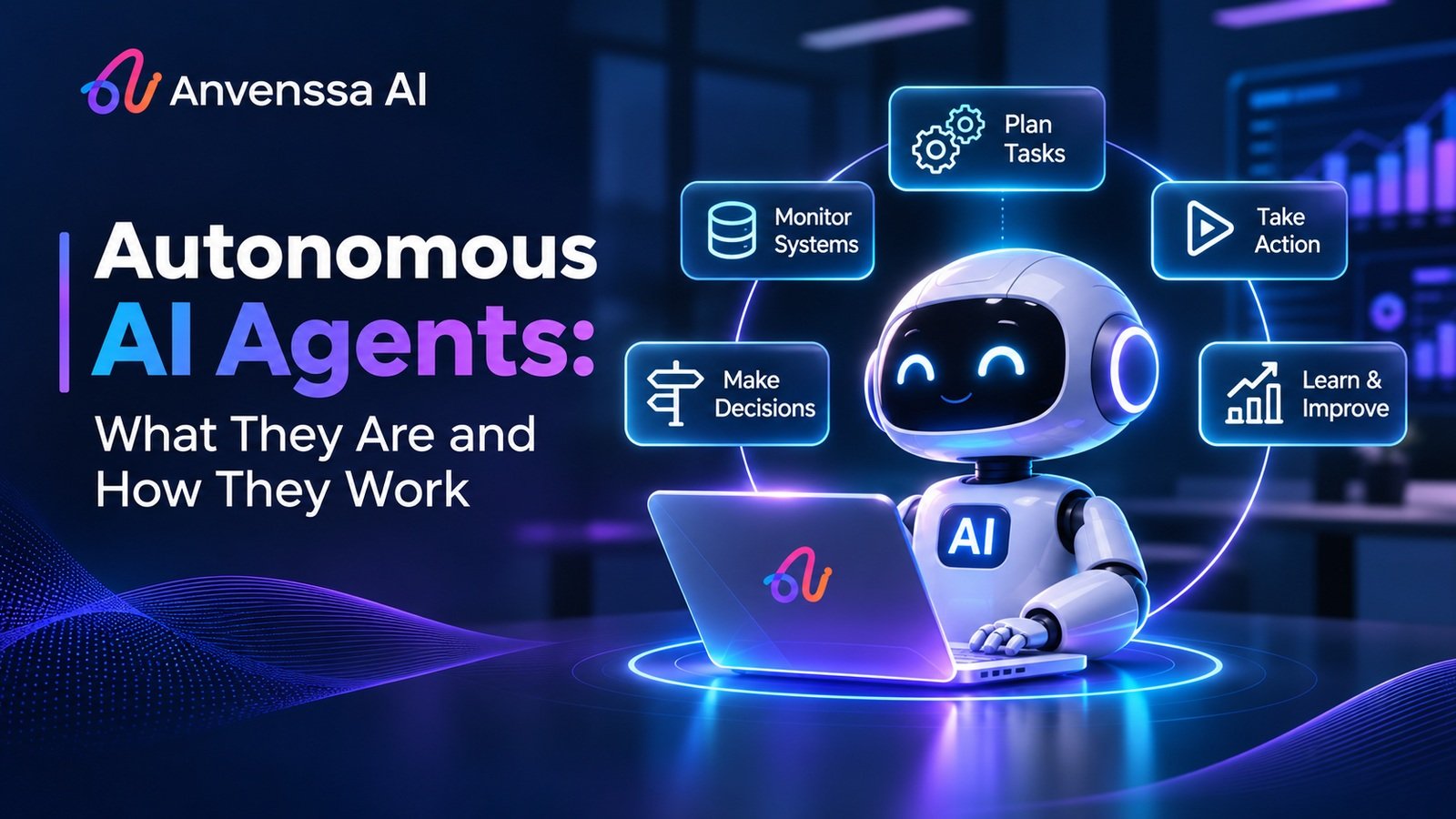
Autonomous AI agents follow a continuous loop. Each cycle builds on the last.
1. Perception and Data Collection
The agent gathers information from the systems around it. This can include customer interactions, transaction records, inventory levels, ERP logs, emails, or external data sources. The quality of what the agent perceives directly affects the quality of its decisions.
2. Decision-Making
Using the information it has collected, the agent identifies patterns, predicts likely outcomes, and chooses the best action given the goal it was assigned.
This is where machine learning and reasoning combine. The agent is not matching keywords or following a flowchart. It is working out what to do next.
3. Action Execution
The agent carries out the action. This might mean creating a purchase order inside an ERP system, sending a notification, routing a task for approval, posting an invoice, or flagging an error.
It uses the tools and integrations available to it.
4. Learning and Adaptation
After acting, the agent observes what happened. It updates its knowledge based on the result and uses that information to make better decisions in the future. Over time, an agent that is well-configured gets more accurate, not less. This loop repeats continuously. The agent does not stop between tasks waiting for someone to tell it to start again. That is what makes it genuinely useful in operational environments where work never stops.
Types of Autonomous AI Agents
Not all autonomous agents work the same way. The type of agent determines how it reasons and acts.
-
Reactive agents: Respond directly to what they observe in the environment. They do not plan ahead. They are fast but cannot handle situations they were not designed for.
-
Deliberative agents: Build a model of the world and plan sequences of actions before doing anything. They are more capable but slower.
-
Hybrid agents: Combine both. They react quickly when needed and plan carefully when the situation calls for it. Most enterprise AI agents are hybrid.
-
Goal-based agents: Evaluate every possible action against the goal they were given and choose the one most likely to achieve it.
-
Utility-based agents: Go a step further. They score each option and pick the one with the best combination of outcomes, not just the one that technically meets the goal.
For business use, hybrid and goal-based agents are the most practical. They handle the structured work reliably and know when a situation falls outside their limits.
Where Autonomous AI Agents Create Real Business Value
The most valuable applications are in environments where large volumes of repetitive, multi-step work currently depend on human judgment. These are the areas where agents deliver the clearest return.
Operations and Supply Chain
Autonomous agents monitor inventory in real time, compare levels against reorder logic and demand signals, pick the right vendor, and raise purchase orders before stock runs out.
When a supply chain problem appears, they can identify it early, redirect shipments, adjust inventory levels, and alert the right people while there is still time to fix it. This is a shift from reacting to problems after they happen to catching them before they do.
Finance and Accounts Payable
Three-way invoice matching, comparing purchase orders, goods receipts, and invoices line by line, is one of the most time-consuming manual tasks in any finance team.
An autonomous agent can handle this continuously, posting matches that fall within tolerance and routing mismatches for human review with the likely reason already identified. Teams spend their time on exceptions, not on routine checks.
Customer Service
An autonomous agent can handle the full arc of a standard customer interaction: receiving the request, checking account history, determining eligibility, completing the action, updating records, and notifying the customer. That is not a chatbot that answers questions. It is a system that completes tasks. For high-volume service environments, the difference in throughput is significant.
Sales and Lead Generation
Agents can prospect, qualify leads based on intent signals, personalise outreach based on what they know about the contact and their company, follow up at the right time, and hand over to a salesperson when the lead is ready. This runs continuously, without the gaps that come from manual outreach.
IT and System Monitoring
Agents can monitor automation and integration logs around the clock, identify errors, suggest a likely root cause, and alert the right person with enough context to act immediately. The agent does not sleep. The engineer does, and wakes up to a lead rather than a mystery.
What Makes a Good Autonomous AI Agent?
https://youtu.be/SYHqSAWQ4NY?si=aasmqpSwAkwYp9X3
The agents that work well in production share a few common characteristics. These are worth checking against any tool you are evaluating.
-
Clear goal definition: The agent knows what it is trying to achieve and what success looks like. Vague goals produce unpredictable behaviour.
-
Defined limits: The agent operates within permissions set by the business. High-impact actions, like large payments or access changes, require human approval.
-
Audit trail: Every action the agent takes is logged. You can see what it did, when, and why.
-
Escalation logic: The agent knows when it cannot finish a task on its own and passes it to a person with enough context for them to act.
-
Integration depth: The agent connects to the actual systems where work happens, including authentication, approval flows, and data sources, not just surface-level APIs.
A useful test before deploying any agent: can you explain exactly what it is allowed to do, stop it quickly if needed, see everything it has done, and name who is accountable for the outcome? If any of those answers is no, the agent is not ready for production.
Autonomous AI Agents in Enterprise Contexts
The gap between enterprise expectations and what generic AI tools deliver is real. A tool with thousands of app integrations may still need significant engineering before it can handle ERP authentication, approval workflows, and audit requirements.
Connector count is not the same as integration depth.
For manufacturing, logistics, and finance teams, the most practical approach is an AI agent layer designed specifically for the systems those teams already use. SAP, Oracle, Dynamics, NetSuite, and Odoo each have their own authentication patterns, data structures, and approval flows. An agent built for general use needs to be configured for all of this. An agent built for ERP starts there.
Anvenssa builds autonomous AI agents for sales, customer support, and marketing automation for B2B businesses. Our agents connect to CRM platforms, communication tools, and business systems to handle the multi-step, repetitive work that currently depends on people. If you want to understand what that looks like for your business, we are happy to walk you through it.
Autonomous vs. Assistive AI Agents
It is worth drawing a clear line between autonomous agents and assistive ones, because they are suited to different tasks.
Assistive AI Agents
An assistive agent, often called a copilot, helps a person work more efficiently. It drafts an email, summarises a document, or suggests the next action. The person reviews and decides. The human is in the loop for every significant step.
Autonomous AI Agents
An autonomous agent completes the task. It may involve a person at defined checkpoints, particularly for high-risk actions, but it does not need someone to approve each step.
It can run a full process from start to finish and report back when done. Most businesses need both. Assistive agents work well for creative and strategic tasks where human judgment adds value at every step. Autonomous agents work well for operational and transactional tasks where speed, consistency, and volume matter more than individual judgment.
Frequently Asked Questions
What Is the Difference Between an Autonomous AI Agent and a Chatbot?
A chatbot responds to one message at a time and relies on the user to drive the conversation. An autonomous AI agent receives a goal, sequences the actions needed to reach it, and completes the task without needing someone to guide each step. The key difference is who controls the workflow.
Do Autonomous AI Agents Need Human Oversight?
Yes, and that is by design. Well-built agents operate inside defined goals and permissions. High-impact actions such as large payments or access changes are routed for human approval. The agent handles the routine work, and people handle the exceptions and high-stakes decisions. Autonomy lives inside guardrails, not outside them.
What Kinds of Tasks Are Autonomous AI Agents Best Suited To?
They work best on multi-step, repetitive tasks where speed, consistency, and volume matter. Common examples include purchase order creation, invoice matching, lead qualification and follow-up, customer query resolution, and system error monitoring. They are less suited to tasks where human creativity, relationship-building, or complex judgment is the main input.
Can an Autonomous AI Agent Work Alongside Existing Software?
Yes. Autonomous agents are designed to connect to the systems a business already uses, including CRM, ERP, communication tools, and databases. The integration depth matters more than the number of connections. An agent that connects at the surface level may still need significant configuration before it handles authentication, approval flows, and audit requirements correctly.
How Does an Autonomous AI Agent Improve Over Time?
After each action, the agent observes the result and updates its knowledge based on what happened. This continuous learning means the agent becomes more accurate over time, as long as it is given clear feedback and operates in a stable environment. It is not static the way rule-based automation is.